
1099 Tax Calculator
Estimate the 2026 tax impact of sole-proprietor 1099 income after business expenses. See incremental federal income tax, Social Security and Medicare self-employment tax, an optional state/local reserve, QBI treatment, and equal quarterly planning amounts.
Estimated 2026 1099 tax impact
$15,037.20
On $60,000.00 net business profit.
- Quarterly reserve
- $3,759.30
- Effective rate
- 25.1%
- After-tax business income
- $44,962.80
Tax attributable to 1099 income
- Federal income-tax change
- $3,559.47
- Social Security (SE)
- $6,870.84
- Medicare (SE)
- $1,606.89
- Additional Medicare Tax
- $0.00
- State/local planning reserve
- $3,000.00
- Total tax impact
- $15,037.20
Quarterly cash reserve
- Federal tax impact
- $12,037.20
- Federal payments entered
- $0.00
- Federal annual amount remaining
- $12,037.20
- Federal amount per quarter
- $3,009.30
- State/local amount per quarter
- $750.00
- Total quarterly reserve
- $3,759.30
Income and deductions
- Gross business income
- $80,000.00
- Business expenses
- $20,000.00
- Net business profit
- $60,000.00
- Deductible half of SE tax
- $4,238.87
- Standard deduction
- $16,100.00
- QBI deduction used
- $7,932.23
- Taxable income after QBI
- $31,728.91
- Marginal federal bracket
- 12.0%
Self-employment tax base
- Net earnings (92.35% of profit)
- $55,410.00
- SS base left before business
- $184,500.00
- SE earnings subject to SS
- $55,410.00
- SS base left after business
- $129,090.00
- Regular self-employment tax
- $8,477.73
2026 sources and payment timing
Federal rules verified 2026-08-12. Equal-quarter reserves assume income arrives evenly. General 2026 federal estimated-tax dates are April 15, June 15, September 15, and January 15, 2027, subject to IRS weekend, holiday, safe-harbor, and annualized-income rules.
What this calculator assumes
- Active U.S. Schedule C sole proprietor using tax year 2026; not an S corporation, partnership, nonresident, minister, farmer/fisher, or territory return.
- Household taxable wages use W-2 box 1. Household Medicare wages use box 5 and include a spouse when filing jointly. Only the 1099 earner's own box 3 Social Security wages reduce that person's SE wage base.
- Other income excludes capital gains and qualified dividends.
- Automatic QBI assumes an eligible active domestic business, no prior QBI loss, and taxable income at or below the published threshold. Use a custom Form 8995-A result above it.
- The state/local rate is your own effective-rate planning assumption, not a jurisdiction-specific calculation. It is applied only to positive profit.
- Credits, AMT, NIIT, special deductions, loss limits, retirement and health-insurance deductions, and uneven-income penalty calculations are excluded.
Formulas, assumptions, and rounding are documented in our calculator methodology.
Built by Will Henschell, data scientist. Formula checked against IRS Revenue Procedure 2025-32 and Publication 334, verified . Editorial policy.
The 2026 1099 Tax Formula
Net business profit equals gross 1099 receipts minus deductible business expenses. Positive profit is multiplied by 92.35% for regular-method self-employment net earnings. The estimate calculates Social Security and Medicare self-employment tax, deducts one-half of regular self-employment tax when estimating adjusted gross income, applies the 2026 standard or entered itemized deduction and QBI treatment, then measures the federal income-tax change with and without the business. An optional user-entered state/local reserve is added separately.
Why W-2 Wages and Other Income Matter
1099 profit sits on top of the rest of the household's ordinary income rather than starting in the 10% bracket. Household W-2 box 1 wages establish that income-tax baseline, and household box 5 Medicare wages reduce the remaining Additional Medicare Tax threshold. The Social Security base is individual, so only the 1099 earner's own box 3 wages consume that person's 2026 base; a spouse's wages do not.
2026 Self-Employment Tax and QBI Rules
For 2026, the Social Security contribution and benefit base is $184,500. Regular self-employment tax uses 12.4% Social Security plus 2.9% Medicare on qualifying net earnings, while Additional Medicare Tax can add 0.9% above $200,000 for single/HOH filers, $250,000 MFJ, or $125,000 MFS after wages are considered. Section 199A is permanent and includes a new $400 minimum QBI deduction for qualifying taxpayers with at least $1,000 of active-business QBI. Automatic QBI stops above the published full-deduction threshold because Form 8995-A limitations become fact-specific.
Quarterly Reserve vs. Required Payment
The displayed quarterly amount is a cash-planning reserve: remaining estimated federal tax divided by four, plus one-fourth of the optional state reserve. It is not a penalty-safe payment instruction. Form 1040-ES and IRS Publication 505 compare current-year tax, prior-year tax, withholding, credits, and income timing; higher-income taxpayers may need 110% of prior-year tax, and uneven income may call for the annualized-income installment method.
Example: $80,000 of Receipts and $20,000 of Expenses
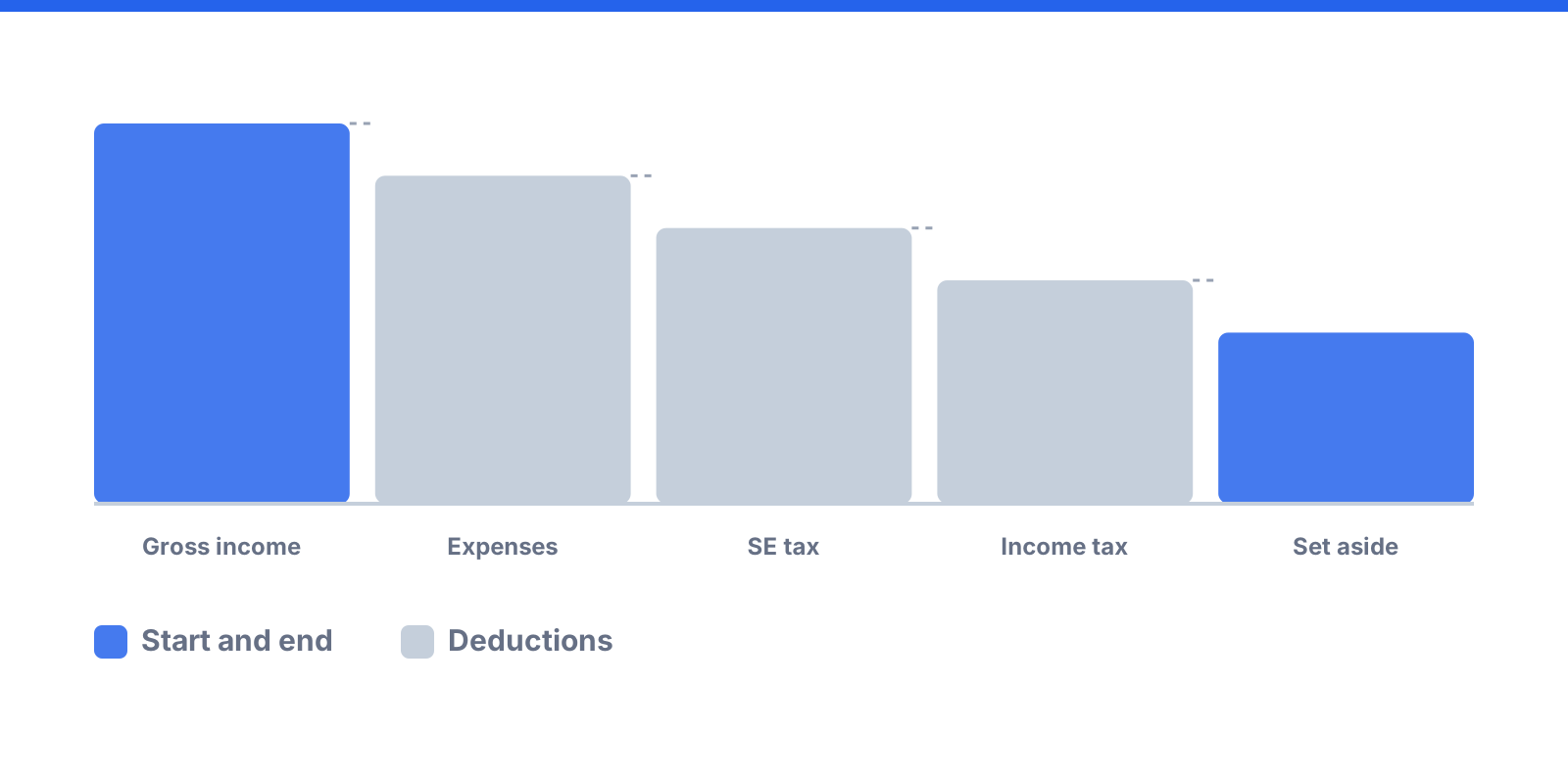
A single filer with $60,000 net profit, no other income, the 2026 standard deduction, automatic QBI, and a 5% state reserve has $55,410 of self-employment net earnings. Regular self-employment tax is $8,477.73, estimated incremental federal income tax is $3,559.47, and the state reserve is $3,000. The total planning impact is $15,037.20, or $3,759.30 per equal quarterly reserve, before any entered federal payments.
Frequently Asked Questions
- The answer depends on net business profit, other household income, filing status, wages, deductions, QBI eligibility, state rules, and withholding. This calculator estimates those layers separately, then divides the remaining federal reserve and optional state reserve into four equal planning amounts. Equal reserves are not a safe-harbor guarantee when income is uneven or prior-year tax changes the required payment.
- Start with net business profit after deductible expenses. The regular method multiplies positive profit by 92.35%. If net earnings are at least $400, Social Security self-employment tax is 12.4% up to the unused 2026 wage base and Medicare self-employment tax is 2.9% without that cap. A separate 0.9% Additional Medicare Tax can apply above a filing-status threshold.
- Ordinary and necessary deductible business expenses reduce net Schedule C-style profit. Lower profit can reduce federal income tax, self-employment tax, QBI, and the optional state reserve. Expense eligibility is fact-specific, so enter only amounts you expect to deduct under current rules and keep the records required to support them.
- Yes, but automatic QBI is deliberately limited to taxable income at or below the full-deduction threshold, where a basic active sole-proprietor estimate can be made without wage, property, or specified-service phase-ins. Above that threshold, the calculator stops automatic QBI and asks for a custom Form 8995-A result rather than guessing.
- It includes an optional reserve using the effective state/local rate you enter. It does not claim to calculate a specific jurisdiction because states differ on deductions, brackets, credits, reciprocity, local taxes, business taxes, and payment schedules. Use 0% if you do not want a state reserve, or enter a rate based on current state guidance or professional advice.
- The general 2026 Form 1040-ES dates are April 15, June 15, September 15, and January 15, 2027, with weekend and legal-holiday adjustments. The IRS periods are not equal-length calendar quarters. Safe-harbor, annualized-income, farmer/fisher, fiscal-year, disaster, and other rules can change the required amount or date.