
Savings Calculator
Calculate how much your savings will grow over time with compound interest. Enter your starting balance, monthly contributions, interest rate, and time horizon to see your future balance and total interest earned.
Future Balance
$32,703.47
Savings Mode
Savings Projection
- Future Balance
- $32,703.47
- Starting Balance
- $1,000.00
- Total Contributions
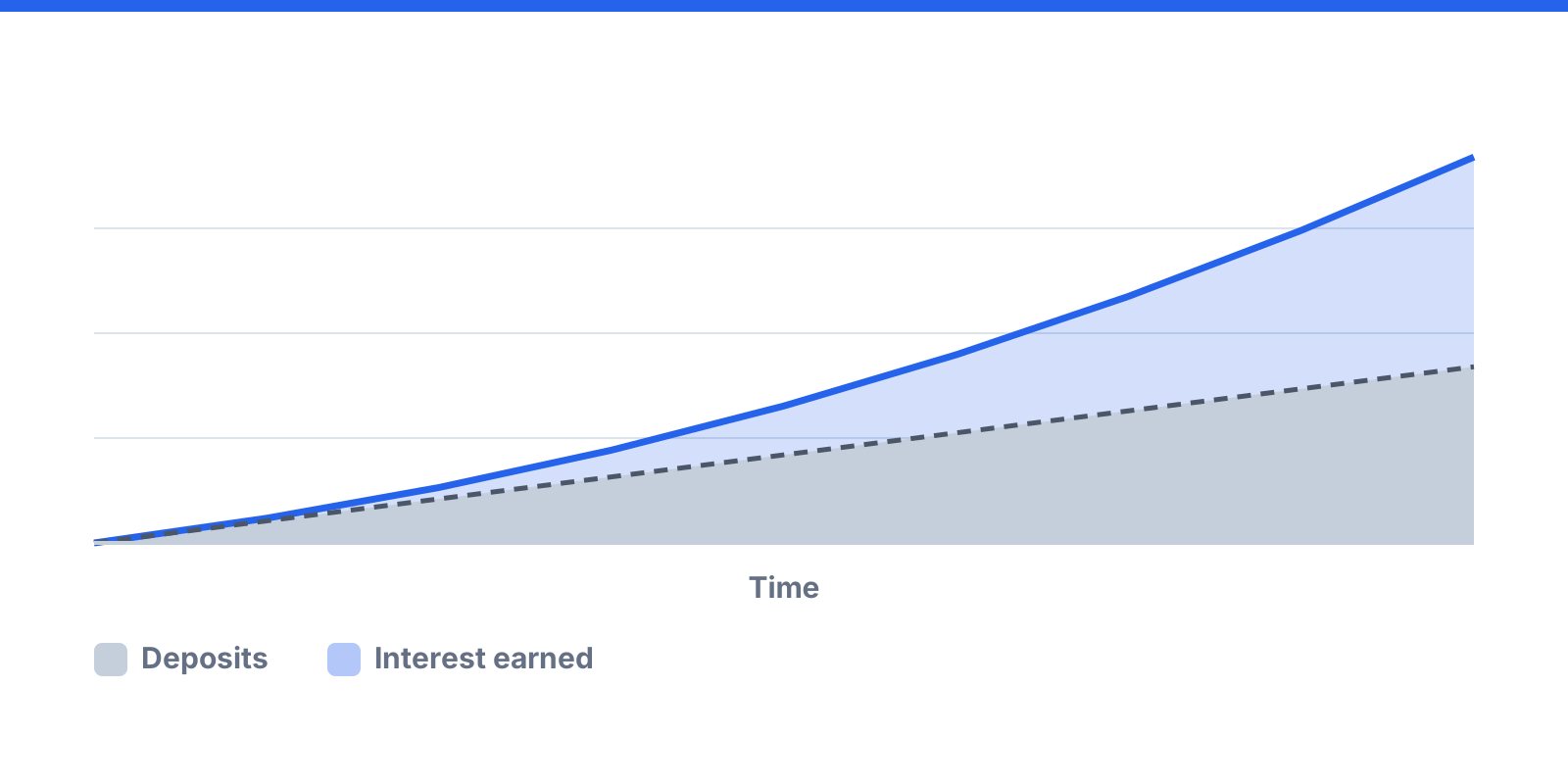
- $24,000.00
- Interest Earned
- $7,703.47
- Inflation-Adjusted Value (2.5%)
- $25,547.89
Growth Breakdown
Compounding Comparison
APY includes compounding. More frequent compounding can slightly raise the effective annual return when the nominal rate is the same.
| Frequency | Effective APY | Projected Balance |
|---|---|---|
| Annual | 5.00% | $32,501.53 |
| Monthly | 5.12% | $32,703.47 |
| Daily | 5.13% | $32,721.89 |
Emergency Fund Examples
A common emergency fund target is 3 to 6 months of essential expenses, with 12 months as a more conservative cushion.
| Scenario | Monthly Expenses | 3 Months | 6 Months | 12 Months |
|---|---|---|---|---|
| Lean | $2,000.00 | $6,000.00 | $12,000.00 | $24,000.00 |
| Typical | $3,500.00 | $10,500.00 | $21,000.00 | $42,000.00 |
| Higher cost | $5,000.00 | $15,000.00 | $30,000.00 | $60,000.00 |
Year-by-Year Savings Growth
| Year | Balance | Total Interest |
|---|---|---|
| Year 1 | $3,507 | $107 |
| Year 2 | $6,142 | $342 |
| Year 3 | $8,912 | $712 |
| Year 4 | $11,824 | $1,224 |
| Year 5 | $14,885 | $1,885 |
| Year 6 | $18,102 | $2,702 |
| Year 7 | $21,484 | $3,684 |
| Year 8 | $25,039 | $4,839 |
| Year 9 | $28,775 | $6,175 |
| Year 10 | $32,703 | $7,703 |
Formulas, assumptions, and rounding are documented in our calculator methodology.
Built by Will Henschell, data scientist. Editorial policy.
Savings Future Value Formula
FV = P(1 + r/n)^(nt) + PMT × [((1 + r/n)^(nt) − 1) / (r/n)]. P = starting balance. r = annual interest rate (decimal). n = compounding periods per year. t = years. PMT = monthly contribution. The first term grows your starting balance; the second term grows your contributions. Both compound simultaneously.
The Cost of Waiting: Why Starting Earlier Matters
Saving $300/month from age 25 to 65 at 7% annual return produces approximately $798,000. Starting the same plan at age 35 produces about $379,000 — less than half — with the same total number of dollars contributed. The 10-year difference at the start is worth more than $400,000 at the end, because early contributions compound for decades longer. Time is the most powerful variable in long-term savings, more so than the contribution amount or rate.
Savings Goals: Emergency Fund, Home Purchase, Retirement
Emergency fund: most financial planners recommend 3–6 months of essential expenses in a liquid, accessible account. For a monthly expense total of $3,000, that means $9,000–18,000. Home down payment: 20% of target home price avoids PMI. For a $350,000 home, that is $70,000. Use this calculator with your target and a savings rate to find how many months it takes. Retirement: the 'multiply by 25' rule suggests you need 25× your expected annual withdrawal in savings — so $50,000/year in retirement requires $1.25 million saved.
Frequently Asked Questions
- Compound interest earns interest on both your original principal and the interest already accumulated. Each period, your balance grows by the interest rate applied to the current (larger) balance — not just the original deposit. The more frequently interest compounds (daily vs. monthly vs. annually), the faster growth accumulates.
- The 50/30/20 rule suggests allocating at least 20% of take-home income to savings and debt payoff. A more targeted approach: decide on a savings goal and a timeline, then use this calculator to find the monthly contribution that reaches your target.
- For a high-yield savings account or money market account, 4–5% APY is a reasonable current estimate. For long-term index fund investment projections, 7% average annual nominal return is a commonly used assumption (roughly 4–5% real return after inflation). Past performance does not guarantee future results.
- APY (Annual Percentage Yield) is the effective annual rate including compounding. A 5% annual rate compounded daily produces an APY of approximately 5.13%. Savings account advertisements use APY. This calculator accepts an annual rate and assumes monthly compounding by default.
- Yes for long-term goals. Inflation reduces purchasing power, so $50,000 ten years from now may buy less than $50,000 today. Use the inflation-adjusted result to compare the future balance to today's dollars.
- A common starting target is 3 to 6 months of essential expenses in a liquid account. People with variable income, single-income households, or higher job risk may prefer 9 to 12 months. Keep emergency funds separate from volatile investments.