
Credit Card Payoff Calculator
Find out exactly how long it will take to pay off your credit card balance and how much total interest you will pay. Compare minimum payments vs. fixed monthly payments and see how extra payments accelerate payoff.
Payoff Summary
- Time to Pay Off
- 4 yr 10 mo (58 months)
- Estimated Payoff Date
- August 2031
- Total Interest Paid
- $3,622.30
- Total Amount Paid
- $8,622.30
- Final Payment
- $72.30
Principal vs. Interest
Formulas, assumptions, and rounding are documented in our calculator methodology.
Built by Will Henschell, data scientist. Editorial policy.
Why High-APR Credit Card Debt Is Expensive
Credit cards often carry APRs of 20–30% — far higher than mortgages, auto loans, or personal loans. At 24% APR, a $5,000 balance costs roughly $100 in interest every month even if you make no new purchases. This is why credit card debt should generally be paid off before building savings or investing: the guaranteed 'return' from eliminating 24% debt far exceeds most investment returns.
Strategies to Pay Off Credit Card Debt Faster
Pay more than the minimum — even an extra $50/month makes a measurable difference. Avoid adding new charges to cards you are paying down. Negotiate a lower APR with your card issuer (success rate varies but costs nothing to ask). Consider a balance transfer to a 0% promotional rate (watch for transfer fees). Automate payments above the minimum to ensure consistency. Apply windfalls (tax refunds, bonuses) directly to your highest-APR balance.
The True Cost of Minimum Payments
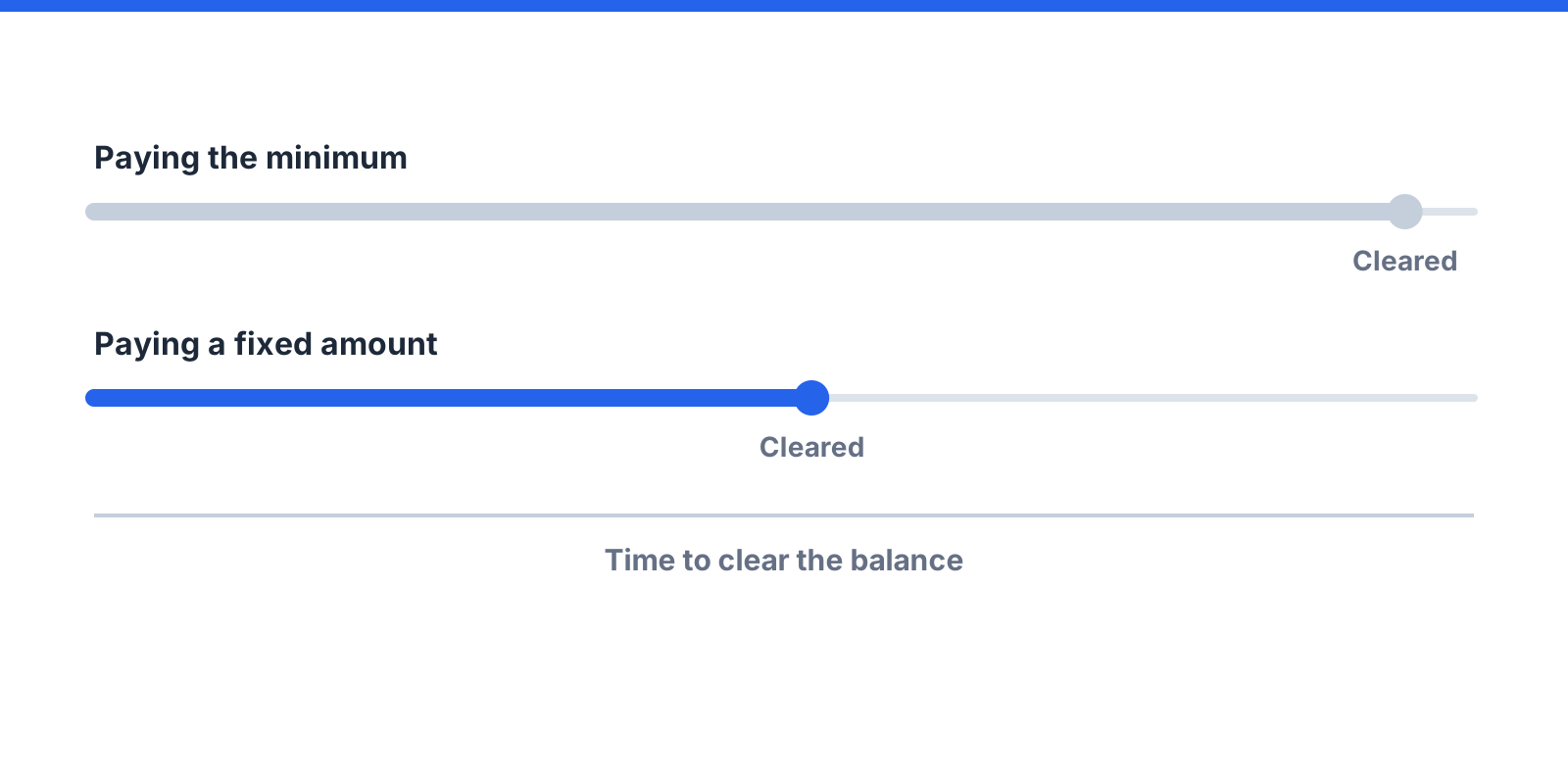
Minimum payments are designed to maximize interest revenue for lenders — not to help you get out of debt quickly. A card with a $10,000 balance at 22% APR with a 2% minimum payment would take over 30 years to pay off making minimums only, costing more than $11,000 in interest — more than the original balance. This calculator shows you these numbers clearly, so you can see exactly what each dollar of additional payment saves you.
Frequently Asked Questions
- Minimum payments are typically 1–3% of your balance. At a high APR, most of the minimum payment covers only interest, leaving very little to reduce principal. On a $5,000 balance at 24% APR, paying a $150 minimum means over $2,000 in total interest and more than 4 years to pay off. A fixed $300/month payment would pay it off in 20 months and save over $1,200 in interest.
- Most US credit cards use daily compounding. Your Daily Periodic Rate = APR ÷ 365. Daily interest = Daily Periodic Rate × current balance. This accumulates throughout your billing cycle and is added to your statement balance each month.
- The debt avalanche: pay minimums on all cards, then put extra money toward the highest-APR card. This minimizes total interest paid mathematically. The debt snowball: pay minimums on all cards, then put extra money toward the smallest balance. This provides faster psychological wins and may help some people stay motivated. The avalanche saves more money; the snowball can be more motivating.
- A 0% APR balance transfer card can save significant interest if you can pay off the transferred balance before the promotional period ends (typically 12–21 months). Watch for balance transfer fees (usually 3–5% of the amount transferred) and what the go-to rate is after the promotional period.
- Extra payments reduce principal immediately, which reduces the interest charged in every subsequent month. On a $5,000 balance at 24% APR with a $150/month base payment, adding $50/month extra (total $200/month) cuts payoff time from about 47 months to 31 months and saves roughly $700 in interest. The earlier in the payoff timeline you add extra payments, the greater the compounding benefit.
- When you pay only the minimum, most of the payment goes to interest rather than principal. Credit card issuers typically set minimums at 1–3% of the balance, which is designed to maximize interest revenue — not to help you get out of debt. As your balance slowly decreases, so does the minimum, meaning you extend the payoff timeline indefinitely unless you commit to a fixed payment amount above the minimum.