
Auto Loan Calculator
Calculate your monthly car payment using vehicle price, down payment, trade-in value, sales tax, interest rate, and loan term. See total interest and total loan cost.
Monthly Payment
$533.36per month
Financing $27,000.00
- Total interest
- $5,001.56
- Total cost
- $35,001.56
State base rate only; local taxes may vary.
Auto Loan Summary
- Monthly Payment
- $533.36
- Amount Financed
- $27,000.00
- Sales Tax
- $0.00
- Total Interest Paid
- $5,001.56
- Total Out-of-Pocket Cost
- $35,001.56
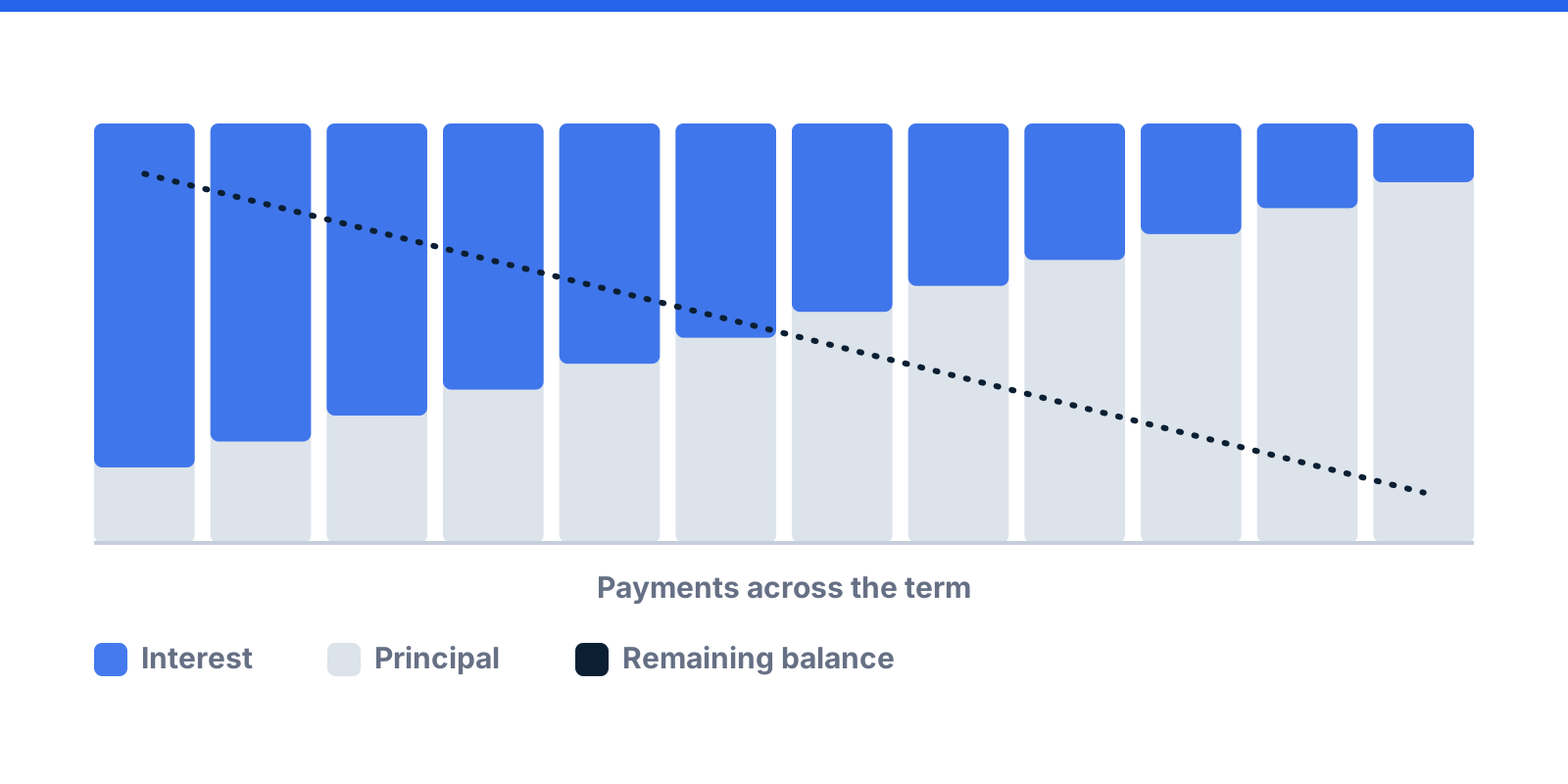
Cost Breakdown
Formulas, assumptions, and rounding are documented in our calculator methodology.
Built by Will Henschell, data scientist. Editorial policy.
How Auto Loan Payments Are Calculated
Start with the vehicle price. In most states, subtract trade-in value first, then apply sales tax to the net purchase price (tax rules vary by state — some tax the full price before trade-in). Add any dealer fees and registration costs. Subtract your down payment. The result is your financed balance. Apply the amortization formula to find monthly payment: M = P × [r(1+r)^n] / [(1+r)^n − 1].
Total Cost of Vehicle Ownership
Monthly loan payment is just one component of vehicle costs. Budget separately for: auto insurance ($100–250/month for most drivers), fuel ($100–200+/month depending on vehicle and driving), maintenance and repairs ($80–150/month average over the vehicle's life), and registration and licensing fees (varies by state). The total monthly cost of ownership is often 1.5–2× the loan payment alone.
Comparing This Calculator to the Car Payment Calculator
Use the Auto Loan Calculator when you know exactly how much you need to borrow and want to see the payment. Use the Car Payment Calculator when you are starting from a sticker price and need to calculate sales tax, dealer fees, and true out-the-door numbers. Use the Car Affordability Calculator first if you want to know your maximum vehicle budget before shopping.
48, 60, 72, or 84 Months: Loan Term Comparison
On a $30,000 auto loan at 6% APR: 48-month term = $704/mo, total interest = $3,800. 60-month term = $580/mo, total interest = $4,800. 72-month term = $497/mo, total interest = $5,800. 84-month term = $436/mo, total interest = $6,600. The monthly savings shrink as the term grows, while total interest keeps climbing. At 84 months, a new car will almost certainly be worth less than the loan balance for the first 2–3 years, leaving you underwater. Most financial planners recommend 48–60 months as the sweet spot between affordability and total cost control.
Negative Equity and Being Underwater on a Car Loan
Negative equity (being underwater) means you owe more on the car than it is worth. New cars typically lose 15–25% of their value in the first year. If you finance $30,000 with no down payment on a 72-month loan, you may owe $27,000 after 12 months while the car is worth $23,000 — a $4,000 underwater position. To protect yourself: put at least 10–20% down, choose a term of 60 months or less, and avoid rolling negative equity from a trade-in into a new loan. Gap insurance covers the difference if the car is totaled while you are underwater.
Frequently Asked Questions
- Your trade-in value is subtracted from the vehicle price (typically before sales tax is applied in states that tax only the net purchase), directly reducing the amount you need to finance. A $5,000 trade-in on a $30,000 car means you finance $25,000 plus tax and fees instead of the full $30,000.
- Generally yes. A larger down payment reduces your loan amount, lowers monthly payments, and reduces total interest paid. It also reduces the risk of becoming underwater on the loan — owing more than the car is worth — since cars depreciate fastest in the first 1–3 years.
- Auto loan rates vary by credit score, loan term, and lender. Borrowers with excellent credit (720+) may qualify for rates under 5–6%. Always compare your bank or credit union's rate against dealer financing before accepting any offer.
- Long loan terms lower monthly payments but significantly increase total interest paid, and cars depreciate faster than long loans pay down principal. This means you may owe more than the car is worth for years. Most financial experts recommend 48–60 months to limit interest and equity risk.
- In most US states, sales tax is added to the vehicle purchase price and rolled into the financed amount. For example, a $30,000 vehicle with 8% sales tax adds $2,400 in tax, raising the financed total to $32,400 before subtracting down payment and trade-in. Some states allow trade-in value to reduce the taxable base — check your state's specific rules. This calculator lets you enter your state's rate directly.
- Yes. Cash rebates from the manufacturer are typically applied directly against the vehicle purchase price, reducing your financed amount. For example, a $1,500 rebate on a $28,000 vehicle means you finance $26,500 (before tax and fees). Dealer-to-dealer incentives or dealer cash may not reduce your price unless specifically negotiated — always confirm the out-the-door price in writing.