
House Affordability Calculator
Find out how much house you can afford based on your gross income, monthly debts, down payment, interest rate, and debt-to-income ratio. See your maximum home price, estimated monthly payment, and front-end and back-end DTI.
Estimated Affordable Home Price
$275,857.18
Limited by front-end DTI — loan amount $235,857.18
Affordability Approach
Housing at most 28% of income - all debts at most 43% of income
Loan Assumption
PMI is usually required below 20% down and can generally be removed once you reach 20% equity.
Estimated Monthly Housing Payment
- Principal & Interest
- $1,490.78
- Property Tax
- $275.86
- Homeowners Insurance
- $100.00
- Total Monthly Housing
- $1,866.63
Debt-to-Income Ratios
- Monthly Income
- $6,666.67
- Front-End DTI (housing / income)
- 28.0%
- Back-End DTI (all debts / income)
- 32.5%
Cash to Close Estimate
- Down Payment Entered
- $40,000.00
- Estimated Closing Costs (3.0%)
- $8,275.72
- Estimated Cash to Close
- $48,275.72
- Conventional Common Minimum Down
- $8,275.72
Conservative vs. Lender-Max Scenarios
These scenarios reuse your income, debts, down payment, rate, taxes, insurance, PMI, and HOA. The aggressive option can resemble a lender maximum; the conservative option is often closer to a comfortable budget.
| Scenario | Max Home Price | Monthly Housing | Back-End DTI |
|---|---|---|---|
| Conservative (28/36) | $275,857.18 | $1,866.63 | 32.5% |
| Common (28/43) | $275,857.18 | $1,866.63 | 32.5% |
| Aggressive (36/50) | $348,709.01 | $2,399.96 | 40.5% |
The aggressive scenario is about $72,851.83 higher than the conservative scenario. Treat that gap as a stress-test zone, not automatic buying power.
Salary-to-Home-Price Examples
Uses your selected DTI approach, debts, rate, term, taxes, insurance, HOA, PMI, and an estimated 14.5% down payment.
| Annual Income | Estimated Home Price | Monthly Housing | Down Payment |
|---|---|---|---|
| $60,000.00 | $202,989.53 | $1,399.98 | $29,434.00 |
| $80,000.00 | $275,857.18 | $1,866.63 | $40,000.00 |
| $100,000.00 | $348,724.83 | $2,333.29 | $50,566.00 |
| $125,000.00 | $439,809.40 | $2,916.62 | $63,773.49 |
| $150,000.00 | $530,893.97 | $3,499.94 | $76,980.99 |
Formulas, assumptions, and rounding are documented in our calculator methodology.
Built and maintained by Will Henschell, Data Scientist. Editorial policy.
How House Affordability Is Calculated
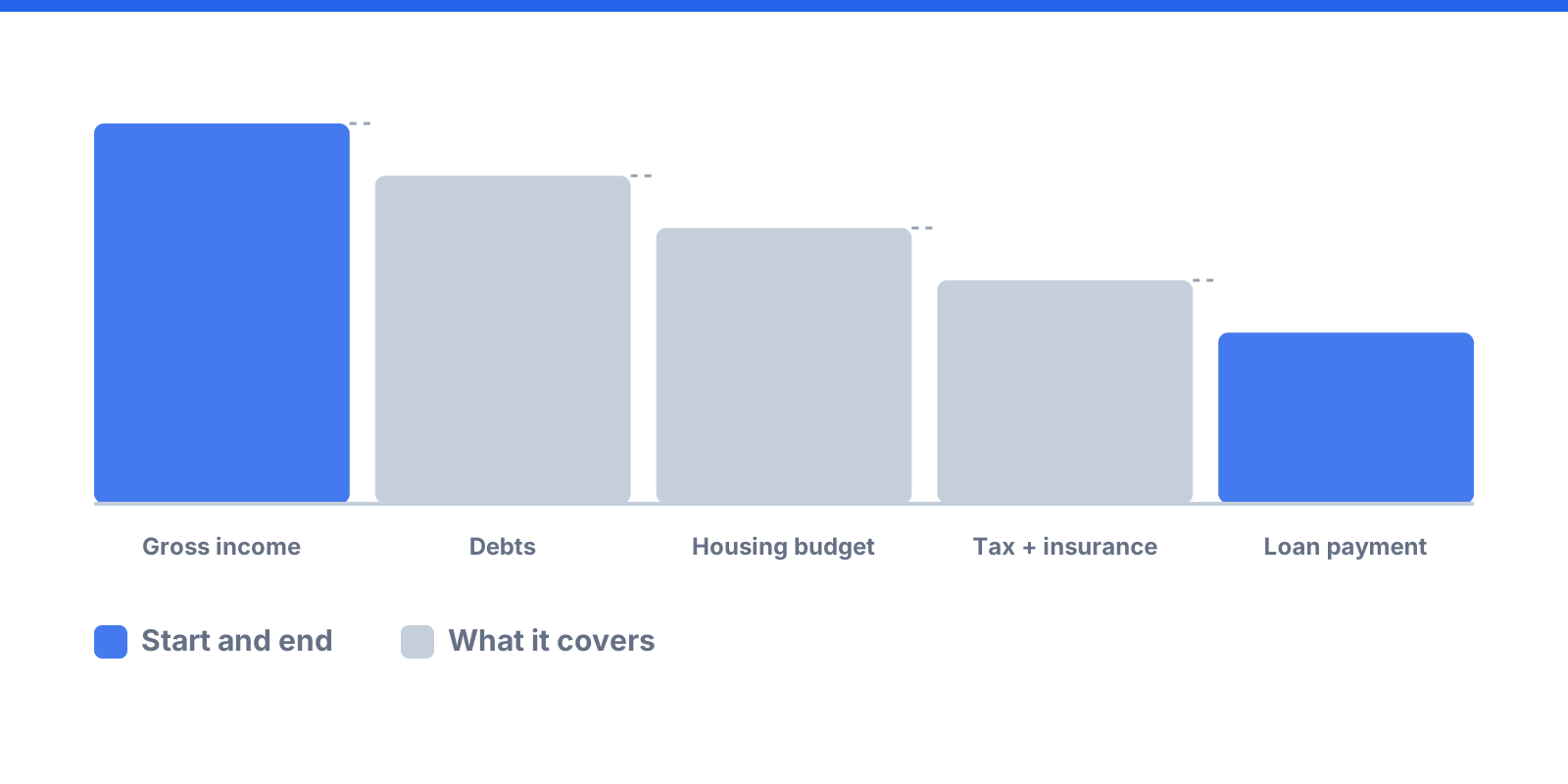
Lenders look at two ratios: front-end DTI (housing payment ÷ income) and back-end DTI (all debts ÷ income). Your maximum home price is the price where your estimated monthly PITI payment stays within both limits, given your down payment and current interest rates.
DTI Targets Explained
Conservative (28/36): housing ≤ 28%, all debts ≤ 36%. Standard (28/43): used by most conventional loans. Aggressive (36/50): used by FHA and some other programs. A lower DTI means more flexibility and better loan terms. Example: $80,000 gross annual income = $6,667/month. At 28% front-end DTI, maximum housing payment = $1,867/month. At 43% back-end DTI with $500/month in other debts, maximum housing = $2,367/month. The binding constraint is whichever limit is lower.
What Is PMI and When Do I Pay It?
Private Mortgage Insurance (PMI) protects the lender if you default. It is typically required when your down payment is less than 20% of the home price. PMI usually costs 0.5–1.5% of the loan amount per year (about $83–$250/month on a $200,000 loan) and can be removed once you reach 20% equity.
Closing Costs and Other Upfront Expenses
The down payment is not your only upfront cost. Closing costs typically add 2–5% of the purchase price: origination fees, title insurance, appraisal, escrow, recording fees, and prepaid interest. On a $300,000 home, budget $6,000–$15,000 in closing costs on top of the down payment. Some programs allow seller concessions (seller pays closing costs) or lender credits in exchange for a slightly higher rate. Always ask for a Loan Estimate from your lender to see itemized costs before committing.
Frequently Asked Questions
- A common guideline is to spend no more than 28% of your gross monthly income on housing (front-end DTI) and no more than 43% on all debts combined (back-end DTI). Use this calculator with your actual numbers for a personalized estimate.
- DTI is your total monthly debt payments divided by your gross monthly income. Lenders use front-end DTI (housing only) and back-end DTI (all debts) to evaluate mortgage applications. Most conventional loans require back-end DTI under 43–45%.
- PITI stands for Principal, Interest, Taxes, and Insurance — the four components of a complete monthly mortgage payment. Some loans also add PMI (private mortgage insurance) and HOA fees.
- 20% down avoids PMI and results in a lower monthly payment. However, many loans allow 3–10% down. A larger down payment reduces your loan amount and total interest paid.
- FHA loans are government-backed and allow down payments as low as 3.5% with a credit score of 580+. They require mortgage insurance premiums (MIP) for the life of the loan if you put less than 10% down. Conventional loans (backed by Fannie Mae/Freddie Mac) require at least 3–5% down with a 620+ credit score. PMI on conventional loans can be removed once you reach 20% equity, unlike most FHA MIP. FHA loans often allow higher DTI ratios (up to 50% with strong compensating factors), which may let you qualify for more home — though not necessarily more than is comfortable to repay.
- Lenders calculate the maximum you qualify for based on income and debt, not on your lifestyle, emergency fund needs, retirement goals, or job security. A lender may approve a $400,000 mortgage when $280,000 is your actual comfort zone. Use this calculator to see multiple DTI thresholds — the conservative (28/36) result is often a better personal budget target than the maximum (36/50) the lender would approve.