
Percentage Calculator
Calculate percentages instantly: find the percentage of a number, determine what percent one value is of another, or calculate percentage increase, decrease, and change. Three calculation modes in one tool.
Result
36
15% of 240 = 36
Calculation Type
15% of 240 = 36
Result = (A ÷ 100) × B
Use this calculator on your site
Add the responsive calculator with a lightweight iframe.
Formulas, assumptions, and rounding are documented in our calculator methodology.
Built and maintained by Will Henschell, Data Scientist. Editorial policy.
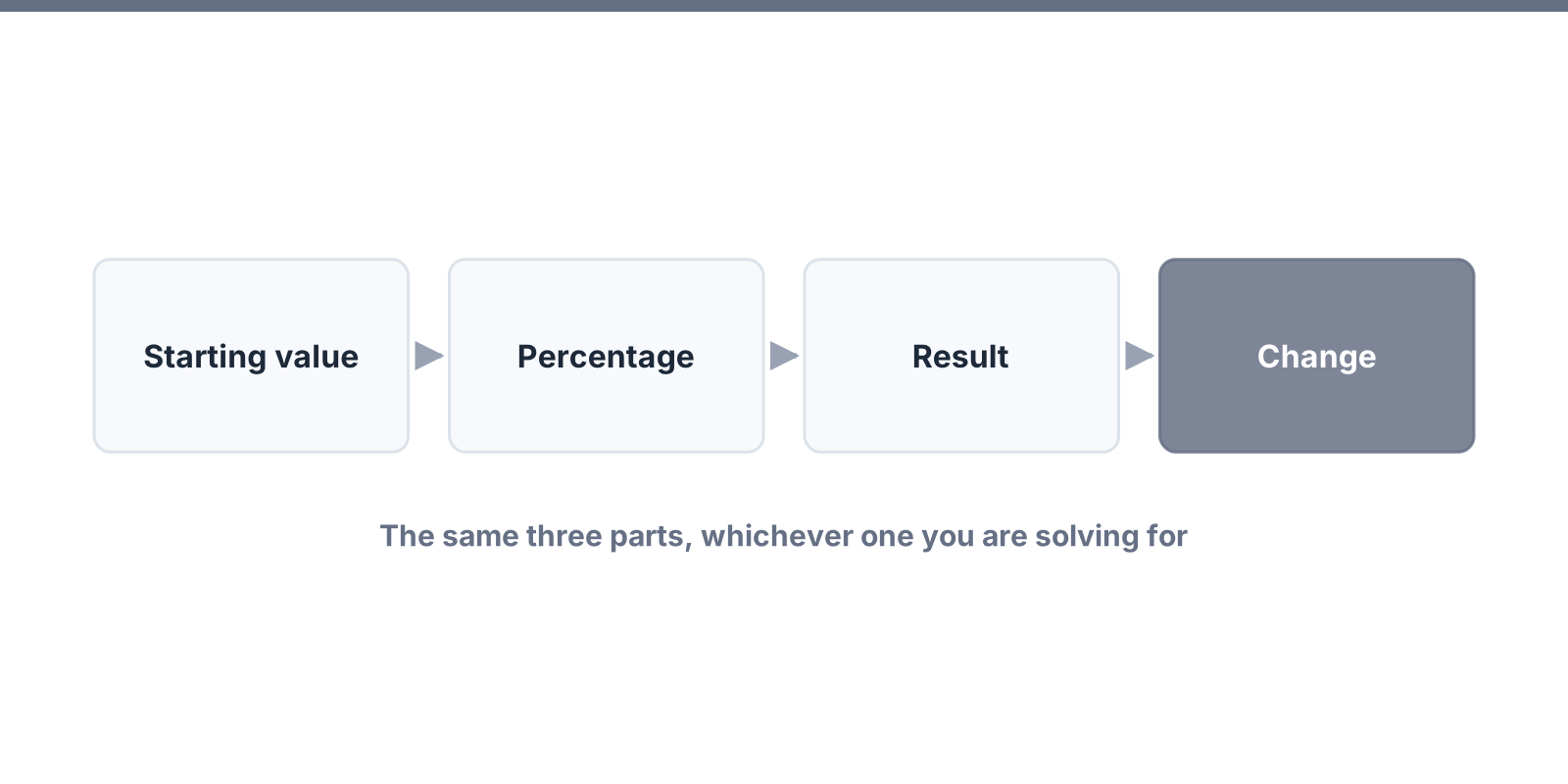
The Three Percentage Formulas
1. What is X% of Y? Answer = Y × (X ÷ 100). Example: 15% of 60 = 60 × 0.15 = 9. 2. X is what percent of Y? Answer = (X ÷ Y) × 100. Example: 12 is what % of 80? (12 ÷ 80) × 100 = 15%. 3. Percent change from X to Y? Answer = [(Y − X) ÷ X] × 100. Example: from 80 to 100: [(100−80)÷80] × 100 = 25% increase.
Percent Change vs. Percentage Points
Percent change and percentage points are not the same thing. If an interest rate rises from 4% to 6%, it increased by 2 percentage points (the absolute arithmetic difference) but increased by 50% (the relative percentage change: [(6−4)÷4] × 100 = 50%). This distinction matters significantly in finance, polling, and statistics. 'Percent change' measures relative change; 'percentage points' measures absolute change in a percentage value.
Common Percentage Calculations by Context
Tax: total = price × (1 + tax rate). Reverse tax (finding pre-tax price): pre-tax = total ÷ (1 + tax rate). Tip: tip = bill × tip%. Discount: sale price = original × (1 − discount%). Grade: grade% = points earned ÷ points possible × 100. Investment return: return% = (current − original) ÷ original × 100. Markup: markup% = (selling price − cost) ÷ cost × 100.
Frequently Asked Questions
- Multiply the number by the percentage and divide by 100. Example: 25% of 80 = 80 × 25 ÷ 100 = 20. Equivalently: multiply by the decimal form of the percentage (25% = 0.25, so 80 × 0.25 = 20).
- Percentage increase = [(new value − old value) ÷ old value] × 100. Example: price went from $50 to $75. Change = $25. Percentage increase = (25 ÷ 50) × 100 = 50% increase.
- Percent change measures how much a value changed relative to the original value. It is directional: a positive result is an increase, negative is a decrease. Percent difference is symmetric — it measures the difference between two values relative to their average, with no direction. Use percent change when comparing before/after; use percent difference when comparing two independent values where neither is the baseline.
- Divide the part by the whole and multiply by 100. Example: 45 is what percent of 180? (45 ÷ 180) × 100 = 25%. This works for grades, completion rates, proportions, and any part-of-whole comparison.
- Discount amount = original price × (discount% ÷ 100). Sale price = original price − discount amount. Example: $120 item at 30% off. Discount = $120 × 0.30 = $36. Sale price = $120 − $36 = $84. Shortcut: sale price = original price × (1 − discount rate) = $120 × 0.70 = $84.
- Percentage decrease = [(original value − new value) ÷ original value] × 100. Example: a price drops from $200 to $150. Decrease = $50. Percentage decrease = (50 ÷ 200) × 100 = 25%. The result is expressed as a positive number representing the magnitude of the drop. This is the same as percentage change when the new value is smaller — the percent change formula returns a negative number, confirming a decrease.