
Compound Interest Calculator
Calculate how an investment grows with compound interest. Enter principal, annual rate, compounding frequency, and years to see future value and total interest earned. Includes simple vs. compound interest comparison.
Future Value
$20,096.61
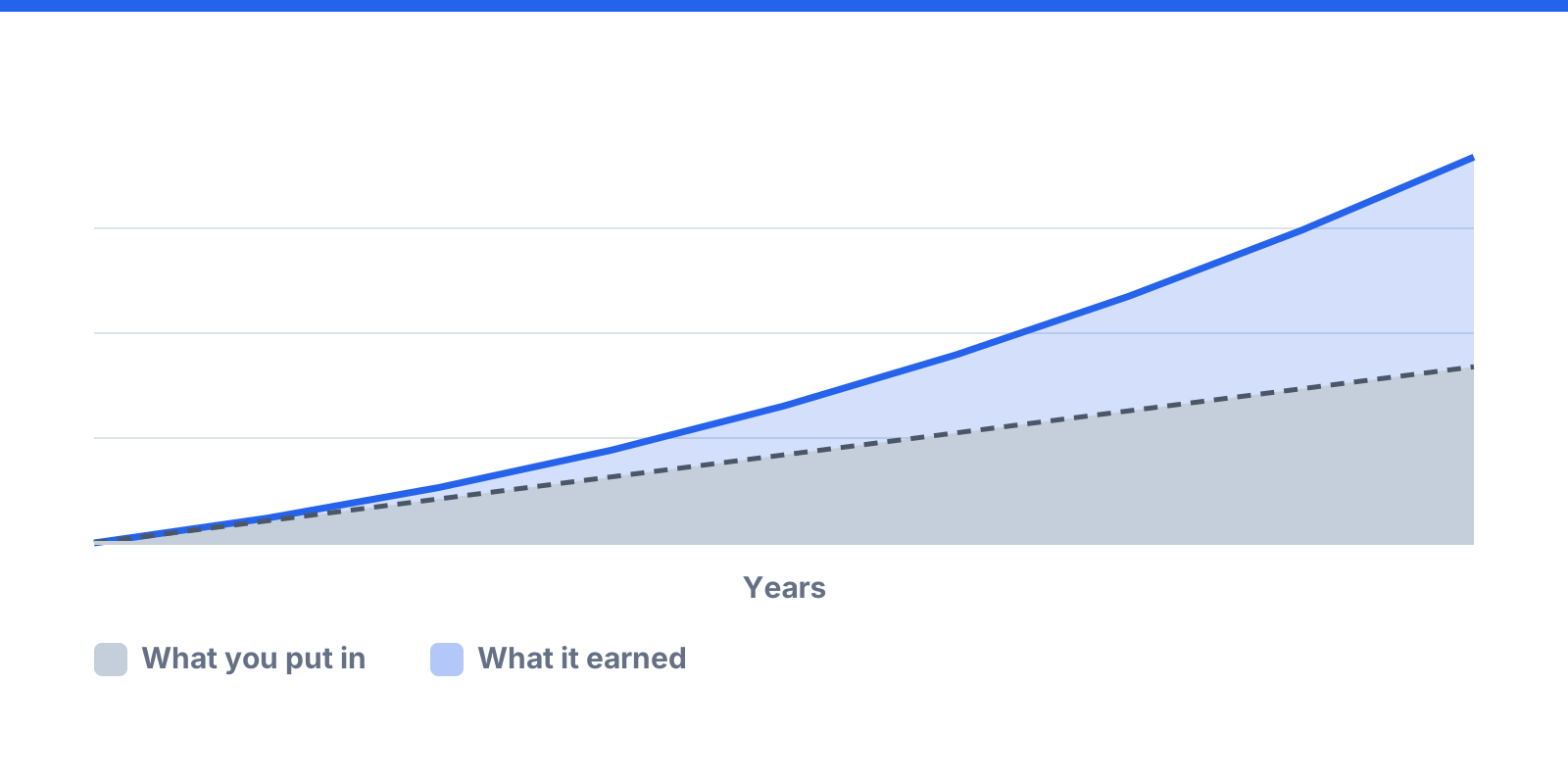
101.0% growth over 10 years, compounded monthly (12x/year)
Compound Interest Results
- Future Value
- $20,096.61
- Principal + Contributions
- $10,000.00
- Interest Earned
- $10,096.61
- Total Growth
- 101.0% (2.01x)
- Inflation-Adjusted Value (2.5%)
- $15,699.44
Contribution Assumptions
- Contribution Amount
- $0.00
- Contribution Frequency
- Monthly
- Contribution Timing
- End of period
- Total Contributions
- $0.00
Simple vs. Compound
- Simple Interest Estimate
- $17,000.00
- Compound Interest Estimate
- $20,096.61
- Compounding Advantage
- $3,096.61
Real and After-Tax Estimate
- Inflation-Adjusted Future Value
- $15,699.44
Principal + Contributions vs. Interest
Rule of 72
At 7% annually, your money doubles approximately every 10.3 years. This shortcut is a rough estimate; compounding frequency and contribution timing can shift the exact outcome.
Year-by-Year Compound Growth
| Year | Balance | Total Interest |
|---|---|---|
| Year 1 | $10,723 | $723 |
| Year 2 | $11,498 | $1,498 |
| Year 3 | $12,329 | $2,329 |
| Year 4 | $13,221 | $3,221 |
| Year 5 | $14,176 | $4,176 |
| Year 6 | $15,201 | $5,201 |
| Year 7 | $16,300 | $6,300 |
| Year 8 | $17,478 | $7,478 |
| Year 9 | $18,742 | $8,742 |
| Year 10 | $20,097 | $10,097 |
Formulas, assumptions, and rounding are documented in our calculator methodology.
Built by Will Henschell, data scientist. Editorial policy.
Compound Interest Formula
A = P(1 + r/n)^(nt). A = final amount. P = principal (starting balance). r = annual interest rate as a decimal (e.g., 6% = 0.06). n = compounding periods per year (1 = annual, 12 = monthly, 365 = daily). t = years. Example: $5,000 at 7% compounded monthly for 15 years: A = 5,000 × (1 + 0.07/12)^(12×15) = 5,000 × (1.00583)^180 ≈ $14,197.
Simple vs. Compound Interest: The Real Difference
$10,000 at 5% for 20 years — Simple interest: $10,000 + ($10,000 × 0.05 × 20) = $20,000. Annual compound: $10,000 × (1.05)^20 = $26,533. Monthly compound: $27,126. Daily compound: $27,181. The compounding advantage grows non-linearly with time: at 30 years, the gap between simple and monthly compound triples compared to the 10-year gap.
The Rule of 72 for Quick Estimates
Years to double = 72 ÷ annual rate. At 3%: 24 years. At 6%: 12 years. At 8%: 9 years. At 12%: 6 years. This works in reverse too: if you want to double in 8 years, you need approximately 9% annual return. The Rule of 72 is most accurate between 2–12%; for higher rates, use 69 or 70 for better precision.
Frequently Asked Questions
- Compound interest is interest earned on both the original principal and the interest that has already accumulated. Each compounding period, your interest is added to the balance, and the next period's interest is calculated on the larger total. This creates exponential rather than linear growth over time.
- More frequent compounding produces slightly higher returns. At 6% annual rate on $10,000 for 10 years: annual compounding → $17,908; monthly compounding → $18,194; daily compounding → $18,221. The difference between monthly and daily is small; the difference between annual and daily is more meaningful over long periods.
- The Rule of 72 is a shortcut: divide 72 by your annual interest rate to estimate the number of years it takes to double your investment. At 6%, doubling time ≈ 72 ÷ 6 = 12 years. At 9%, ≈ 8 years. At 12%, ≈ 6 years. It works best for rates between 3% and 15%.
- Simple interest is calculated only on the original principal: I = P × r × t. Compound interest is calculated on the growing balance: A = P(1 + r/n)^(nt). On $10,000 at 5% for 20 years: simple interest produces $20,000; monthly compounding produces $27,126 — a $7,126 difference from compounding alone.
- For diversified stock index funds over long periods, 7% nominal (or 4–5% real after inflation) is a frequently used historical average. Bonds are typically lower. High-yield savings accounts and CDs vary with interest rate environment. These are historical averages, not guarantees.
- Yes. Contributions made at the beginning of each period (annuity due) earn one extra period of interest compared to contributions at the end (ordinary annuity). On a $500/month contribution at 7% for 30 years: end-of-month contributions → approximately $566,764; beginning-of-month contributions → approximately $570,148. The gap widens with higher rates and longer horizons. In practice, most retirement account automatic contributions are treated as end-of-period.